

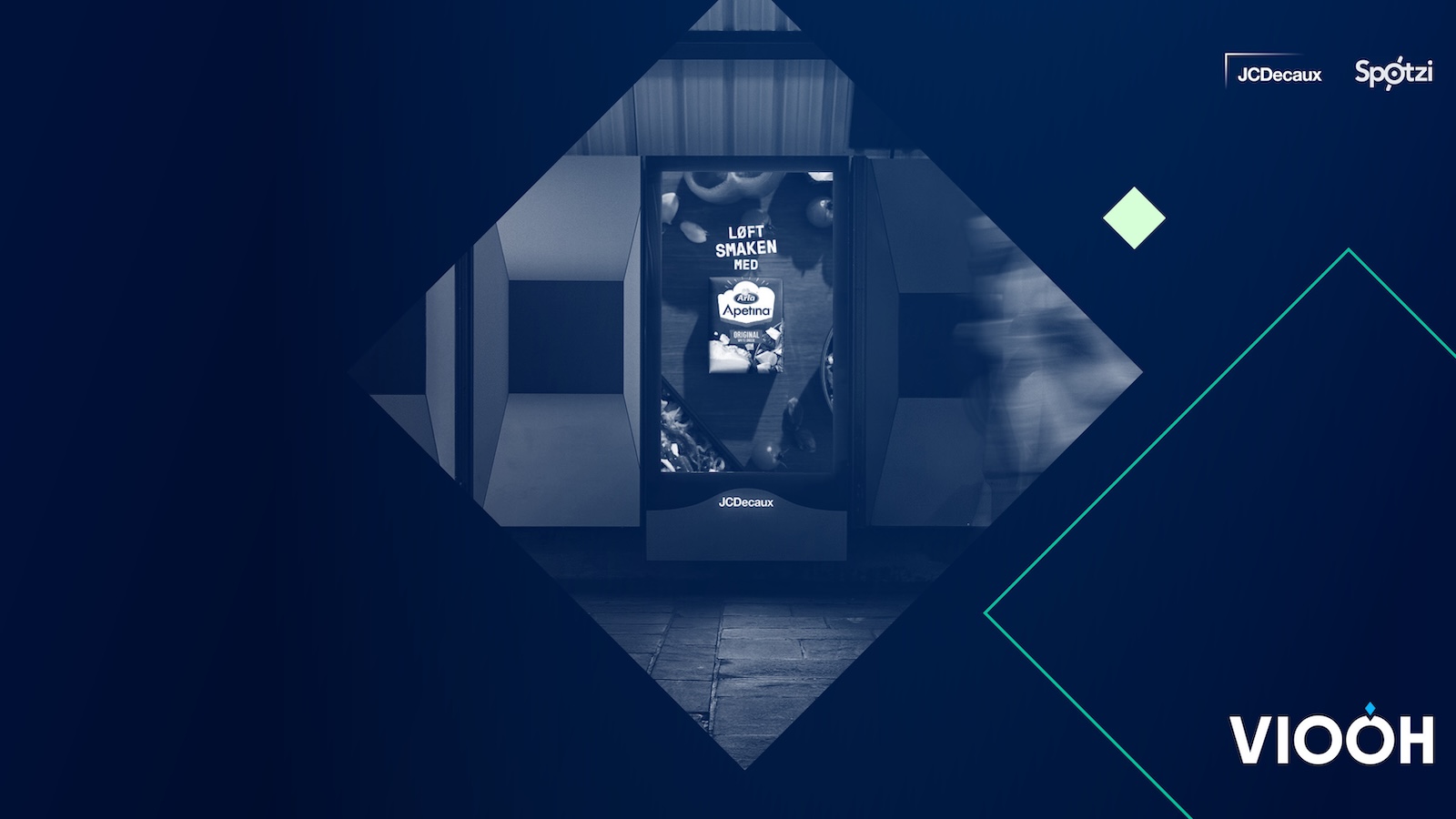
All nine of dairy supplier Arla Foods’ programmatic digital out-of-home campaigns in Norway delivered an increase in store visits, with consumers typically visiting a retailer less than two days after exposure.
The findings challenge the perception of DOOH as primarily a brand-awareness channel.
Here, Gavin Wilson of VIOOH examines the results and busts four persistent myths about programmatic outdoor advertising…


Most of what advertisers believe about programmatic digital out of home (pDOOH) is already out of date. Many still see it as an awareness channel that’s bought through one media owner at a time, has little data behind it and gets planned in isolation.
None of these assumptions holds true anymore and budgets are moving accordingly.
Our recent report with Arla Foods, The Proof is Physical, shows why. Arla had been an advocate for out of home for years, and wanted to take the next step forward with their programmatic strategy to get a full picture of its impact and of how it worked with the rest of its media.
To get a better understanding, Arla tracked a selection of pDOOH campaigns in Norway throughout 2025, a market where 89% of marketers are now shifting spend from other digital channels into pDOOH.
All nine campaigns lifted store visits, and on average consumers went to a store less than two days after seeing an ad.
The results show that pDOOH has moved well beyond brand-building – it is now one of the most accountable, immediate performance channels available to marketers. Arla’s willingness to test the format across nine campaigns and a full portfolio of brands gives the industry robust evidence base for what real-time, data-driven media can deliver.
So, with this robust data to reiterate the power of pDOOH, I wanted to bust four myths to encourage advertisers and media buyers to rethink their approach. These include:
Myth one: You have to buy each media owner on its own
In our 2026 State of the Nation research, 58% of buy-side respondents said they’re likely to consider curated environments in the near future, alongside buying inventory from each media owner directly.
Programmatic DOOH can now be bought in three ways. Private marketplaces run as an auction for one media owner’s inventory, with no set volumes or prices. With programmatic guaranteed deals, buyers and sellers agree volumes and a fixed price up front. Curated marketplaces, which became a new option over the last 18 months, is a single deal ID that gives premium scale across multiple media owners, with data layered on top.
For buyers, curation is simple, efficient and it reflects a bigger shift: pDOOH is becoming an audience buy, not just a location or screen buy. Buying a single media owner still has real value, but advertisers can now also buy audiences across a whole range of them, bringing pDOOH in line with other digital media channels already trading on audience-led buying.
Myth two: There’s no data in out of home
There’s actually plenty of data, at both planning and execution. Campaigns can target specific locations and screens, use footfall data to reach consumers in business districts or airports, and plan against first-party and advanced audience datasets to reach people most likely to buy.
At execution, dynamic creative optimisation (DCO) brings that data to life. It allows advertisers to adjust creative in real time, so the message on screen reflects what’s happening around the viewer. A brand can tailor its message to screens near a concert or event, react to live sports results, or change what it says depending on the time of day.


Someone on their morning commute can see a different ad from someone heading home at night. It’s a simple way to make out-of-home feel as relevant and timely as any digital channel.
Weather is one of the simplest and most effective triggers. When conditions change, brands can switch the message on screen to match how people are feeling and what they’re likely to buy. Arla saw how much weather shapes demand with Starbucks Tripleshot. The launch campaign in March and April delivered a 5% lift in store visits.
When Arla ran a follow-up in June and July, the lift rose to 41%, as warmer weather drove demand for drinks on the go.
All of this can be measured for post-campaign data. For example, Arla’s campaigns used foot traffic attribution with Spotzi and JCDecaux. It tracked anonymous mobile signals from the moment someone passed a screen to a store visit within about five days, and compared the results with a pre-campaign control group.
Myth three: Programmatic DOOH is planned on its own
Consumers move between media channels throughout the day. They might see a campaign at lunch, again on Instagram in the afternoon, then on a digital screen on the way home. Arla rarely treats any channel as standalone. Instead, it plans its media like an orchestra, with each channel an instrument.
For Apetina, each channel had a distinct job. YouTube built broad awareness through high-attention, non-skippable formats. Social media, where people go for food ideas, carried recipe inspiration and storytelling. pDOOH took the campaign into the physical world, using location, venue and time of day to appear close to where people buy.
The first campaign achieved a 7% lift and 229,772 incremental store visits, rising to a 29% lift in the autumn.
Arla’s measurement didn’t crown a single winning channel. YouTube didn’t win, and neither did social or pDOOH. Results were strongest when consumers saw the message across several touchpoints, with pDOOH reinforcing what digital channels had built. That fits wider evidence that digital ads primed by out-of-home exposure get 37% more attention.
Myth four: Programmatic DOOH is only for branding
The Starbucks Tripleshot launch aimed to drive trial among 18 to 44-year-olds. Screens near stockists and in locations popular with commuters reached people on the go who were most likely to act, generating 145,301 incremental store visits. Arla Protein, placed near points of purchase and in high-traffic venues, delivered a 23% lift and 297,745 incremental visits.
Castello, by comparison, was about inspiring premium gifting. Its April campaign drove 438,999 incremental visits. Its Christmas activation peaked at a 71% lift between November and December, with nearly half of the visitors coming from high-income households.
The objectives were very different, but the channel was the same. Targeting by venue, location and time of day let pDOOH flex between broad awareness and changing behaviour.
What stood out most for Arla wasn’t the size of any single result, but how consistently uplift appeared throughout the year. It showed that pDOOH can deliver lower-funnel performance as well as awareness, when placed in the right context at the right moment.
The lessons for advertisers are clear; use curated deals to reach audiences across media owners through a single entry point, put first-party data and real-time triggers such as weather and time of day at the heart of planning, give pDOOH a defined role in the omnichannel plan, and judge it by what it adds to the whole campaign.
Also, consider setting lower-funnel goals such as store visits, using location and timing to reach people close to the point of purchase.
Arla has moved beyond experimenting with pDOOH. Its next step is to make the media channel work harder, adjusting messaging and optimising campaigns in real-time. The brands that follow will turn street-level screens into real-world results.